


The Asian Cup has been a tournament marked by mediocrity, with swathes of forgettable football leaving behind nothing more than blank patches of memory.
The Asian Cup has been a tournament marked by mediocrity, with swathes of forgettable football leaving behind nothing more than blank patches of memory.
The Asian Cup has been a tournament marked by mediocrity, with swathes of forgettable football leaving behind nothing more than blank patches of memory.
The proximity of stadia meant that when the knockout stage began, fans and journalists could go to more than one match in a day.
As the last 16 began, I went to Jordan-Vietnam in early afternoon in Dubai and, despite extra-time and penalties, made it to Iran-Oman an hour and a half away in Abu Dhabi in the evening.
The distances in Qatar will be even shorter.
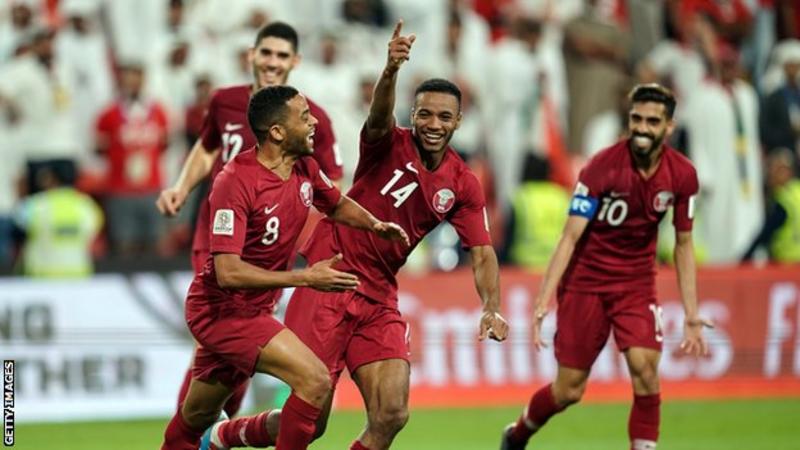
Another instructive taster of what might come in 2022 has been the team that will play as hosts.
Perhaps because of the backdrop of mediocre football, Qatar's bright and technically superior game has caught the eye.
They have scored more and conceded fewer goals than anyone else. In fact, no-one has been able to score against them yet.
In marauding left-back Abdulkarim Hassan they have the reigning Asian Player of the Year, in Almoez Ali, they have the tournament's leading scorer and in Akram Afif, its top assist-provider.
They have defeated three former Asian champions en route to the final, where they will meet a fourth in Japan on Friday at 14:00 GMT.
Qatar's coach, Felix Sanchez, says it's the most important match in the national team's 49-year history and team captain Hassan Al-Haydos doesn't disagree.
"There are no words for me to describe how it feels. The final is the most important thing for me," he said.

"I've played nearly 130 times (for Qatar) but this game is something completely different."
In short, Qatar are ahead of schedule in their World Cup preparations.
Their success in the United Arab Emirates has come against adversity, but it is also the result of eye-watering investment.
Due to the blockade of Qatar by the UAE, Saudi Arabia, Bahrain and Egypt, it's almost impossible for Qataris to enter the Emirates.
That has meant that the Maroons, as they are known, have been the ultimate away team.
When they played North Korea in a group match, the official attendance was 452. When they played Saudi Arabia, their anthem was booed.
And when they played the UAE in a semi-final in which the hosts were humbled 4-0, shoes were thrown at them.
"It's difficult for everybody," said Qatar's Portugal-born right-back, Pedro Correia. "But all the players were ready because we play like a family and we don't care about the (lack of) supporters."
In this case, the description of the team as a family is more than a casual platitude. Two-thirds of Qatar's squad grew up together as scholars in the world-class Aspire academy that has also produced the reigning high jump world champion Mutaz Essa Barshim.
The Qatari defensive midfielder, Assim Madibo, is one of those graduates.
"I've known Almoez (Ali) for eight years," he said.
"We are not only team-mates, we are a family. We're one group, inside and outside the field."
Aspire's cost is thought to be close to a billion pounds. In addition to the academy, it owns European clubs which it uses to give exposure to its young players.
So perhaps, this success is nothing more than investment should provide.
The man who has had a profound guiding impact on many of Qatar's players is the 43-year-old Felix Sanchez.
He was a coach at Barcelona's La Masia academy before moving to Aspire in 2006, when he began by coaching under-11 teams.
But it was in 2014 when he made a mark internationally, by taking Qatar to the Asia Under-19s title with a squad that included several players who will face Japan.
"I was 15 or 14 when I met him," said Madibo. "He's like a father for me."
Sanchez says that victory over Japan would be a vindication for Qatar's extraordinary investment in football.
"If we win the trophy, it will mean that a lot of things have been done the right way and this group of players have been going in the right direction with the right mentality," he said.
"It doesn't matter what happens (in the final) because we are feeling very proud about that."
The appeal by the UAE to have Qatar thrown out of the tournament for fielding ineligible players is a reminder that the Qataris' past practice of liberal naturalisation has only recently ended.
For many years, Qatar's national team was known sneeringly and rather hypocritically by its Arab neighbours as the 'United Nations of Qatar'.
In those days, Qatar would bring a Latin American feel to Asian football, but only via the teamsheet.
But in the current squad, the overwhelming majority of players were born in the country.
The Qatar Football Association decided that using swiftly naturalised players was nothing more than a quick fix.
What it needed was a generation of players with a native attachment to the country, who will be around for years to come.
So stand up Akram Afif, Almoez Ali, Hassan Al-Haydos and the rest.

No comments:
Post a Comment